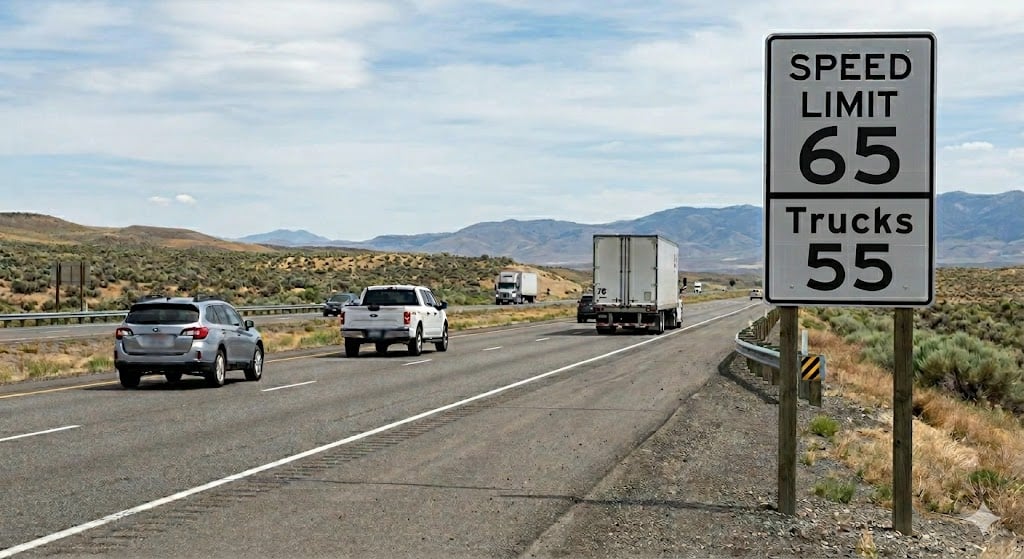
For years, drivers on Idaho’s interstates have been accustomed to a “split speed limit.” While passenger vehicles cruised at 80 mph in rural areas, massive commercial trucks were legally required to maintain a slower pace—typically 10 mph below the posted limit for cars.
However, a significant shift in Idaho law is about to change the landscape of our highways. House Bill 664, passed during the 2026 Idaho Legislative Session, eliminates these speed differentials. As a personal injury firm dedicated to protecting the rights of those injured on our roads, we believe it is vital for every Idahoan to understand the ramifications of this change.
House Bill 664 amends Idaho Code Section 49-654, effectively removing the requirement that large vehicles travel slower than passenger cars. Specifically, the law provides that speed limits for vehicles with five or more axles operating at a gross weight of more than 26,000 pounds shall now be the same as for other vehicles.
Prior to this change, Idaho maintained a 10-mph buffer between semi-trucks and cars in many areas. Proponents of the bill argued that uniform speeds would improve traffic flow and reduce “speed variances”—the gap in speed between the fastest and slowest vehicles. However, from a legal and safety perspective, this standardization removes a critical safety margin that accounted for the sheer physical differences between a 4,000-pound sedan and an 80,000-pound tractor-trailer.
While the law may have changed, the laws of physics have not. Increasing the legal speed limit for the largest vehicles on our roads creates several distinct dangers for Idaho drivers:
Increased Stopping Distance: A fully loaded semi-truck traveling at 80 mph requires significantly more distance to come to a complete stop than one traveling at 70 mph. In emergency braking situations on I-84 or I-15, those extra feet can be the difference between a near-miss and a fatal rear-end collision.
Greater Force of Impact: Kinetic energy increases exponentially with speed. A high-speed collision involving a heavy commercial truck is far more likely to result in catastrophic or “underride” injuries for those in smaller passenger vehicles.
Reduced Reaction Time for Truckers: At higher speeds, truck drivers have less time to react to road hazards, sudden traffic shifts, or inclement weather. Idaho’s unpredictable wind and snow already make high-speed trucking a challenge; removing the speed buffer only heightens the risk of jackknife accidents and rollovers.
As HB 664 takes effect on July 01, 2026, we urge all Idaho drivers to remain extra vigilant on the freeway. Give large trucks plenty of space, avoid “no-zone” blind spots, and be mindful that the truck in your rearview mirror may now be approaching at a much higher rate of speed than you are used to.
Standardizing speed limits might simplify the rules of the road, but it does not diminish the responsibility of trucking companies to operate safely.
If you suffer an injury while driving on the interstate, do not navigate the aftermath alone. Our team is here to investigate whether speed, maintenance, or driver fatigue played a role in your accident. Stay safe out there, Idaho—but if the unthinkable happens, reach out to us to ensure your rights are protected.