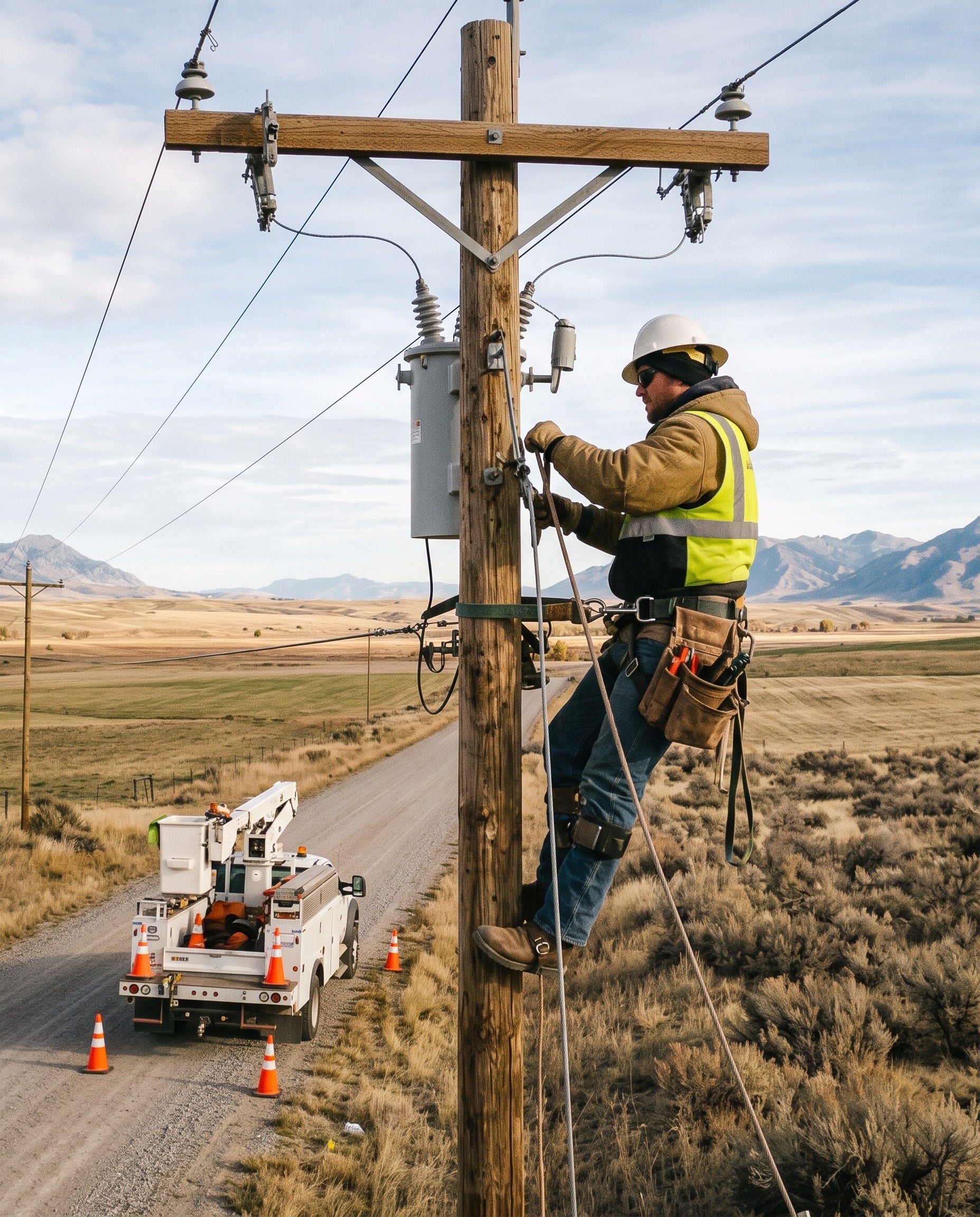
Utility line work is routinely ranked among the most hazardous occupations in the United States. Linemen work in extreme environmental conditions, manage live high-voltage conductors, operate heavy mechanical equipment, and perform high-angle tasks at significant elevations. Across Idaho—from rural cooperatives maintaining miles of distribution lines to urban transmission upgrades—line crews face constant exposure to severe industrial hazards.
When an electrical contact incident, equipment failure, or fall occurs, the resulting trauma can permanently disrupt a worker’s livelihood. While workers’ compensation provides an exclusive statutory remedy against direct employers under Idaho law, the administrative process involves strict procedural requirements, aggressive insurance carriers, and distinct legal intersections involving third-party negligence.
This guide outlines how Idaho workers’ compensation functions for injured linemen.
1. Common Linework Hazards and Severe Workplace Injuries
Due to the physical nature of electrical transmission and distribution maintenance, injuries sustained on the job tend to be catastrophic rather than minor:
-
High-Voltage Electrical Contacts: Flashovers, arc flashes, and direct contacts can cause fourth-degree thermal burns, severe internal soft-tissue and organ destruction, cardiac dysrhythmia, and secondary neurological damage.
-
Catastrophic Falls: Despite modern fall-arrest equipment, hardware shear, gaff cutouts on wood poles, and bucket failure can cause severe traumatic brain injuries (TBIs), spinal cord trauma, and complex orthopedic fractures.
-
Bucket Truck and Derrick Failures: Hydraulic line ruptures, boom collapses, and vehicle rollovers on uneven terrain frequently trap or crush technicians.
-
Repetitive Stress and Crush Trauma: Constant pulling, rigging, setting poles, and heavy lifting frequently result in torn rotator cuffs, cervical disc herniations, and lumbar spine injuries requiring surgical intervention.
2. Idaho Workers’ Compensation: The Governing Framework
Under the Idaho Worker’s Compensation Act (Title 72 of the Idaho Code), injured workers do not need to prove fault or negligence by their employer to receive statutory benefits. In exchange, the law bars employees from suing their direct employer or direct co-workers for common-law negligence.
All claims in the state fall under the administrative jurisdiction of the Idaho Industrial Commission (IIC). If your claim is accepted, Idaho law provides three core benefit categories:
A. Medical Benefits
The employer’s workers’ compensation surety (insurance company) is responsible for providing all reasonable and necessary medical treatment related to the industrial accident. This includes emergency room care, burn center stabilization, surgical reconstruction, rehabilitation therapies, medical hardware, and prescription medications.
B. Temporary Disability Benefits (TTD / TPD)
If an authorized physician certifies that you are unable to work during your recovery period:
-
Temporary Total Disability (TTD): Replaces a percentage of your average weekly wage (subject to statutory minimums and maximums established annually by the State of Idaho) until you reach Maximum Medical Improvement (MMI).
-
Temporary Partial Disability (TPD): Payable if you return to light-duty work at a lower rate of pay or for reduced hours while still recovering.
C. Permanent Impairment and Disability (PPI / PPD)
Once your condition stabilizes and reaches Maximum Medical Improvement, an evaluating physician assigns a Permanent Partial Impairment (PPI) rating. This reflects permanent anatomical loss or functional limitation.
3. Identifying Third-Party Liability Beyond Workers’ Compensation
While workers’ compensation pays medical expenses and a portion of lost wages, it does not provide recovery for non-economic damages, such as general pain and suffering, loss of enjoyment of life, or full past and future lost earnings.
However, the exclusive remedy rule protects only your direct employer and direct co-workers. Many line construction and maintenance projects involve multiple separate entities on a single job site. If a third party’s negligence caused or contributed to the injury, you can bring a separate third-party personal injury lawsuit alongside your workers’ compensation claim:
-
Defective Safety Equipment & Machinery: Defective dielectric bucket liners, faulty harness latches, defective pole gaffs, or manufacturing flaws in hydraulic booms (governed by product liability principles).
-
Negligent Subcontractors or General Contractors: Civil contractors who compromise underground vaults, fail to locate existing utilities, or create site-wide hazards.
-
Third-Party Motorists: Distracted or impaired drivers entering work zones, violating utility flagger signals, and striking utility vehicles or pole setups.
-
Independent Utility / Property Owners: Negligent maintenance of utility easements or defective co-located communication lines installed incorrectly by third parties.
A successful third-party action allows injured line workers to recover full compensation, though it requires coordinating with statutory subrogation liens asserted by the workers’ comp surety.
4. What Steps Should You Take Immediately After a Linework Injury?
-
Report the Accident in Writing: Provide your foreman or safety director with a factual, written account detailing how, when, and where the incident occurred. Request and retain a physical copy.
-
Seek Prompt, Specialized Care: Linework injuries—particularly electrical entries, exits, and arc blasts—can create silent internal tissue necrosis and cardiac strain. Insist on a thorough evaluation.
-
Be Specific with Medical Providers: Clearly state to every nurse, doctor, and therapist that your injury occurred on the job so that intake records reflect industrial origin from Day 1.
-
Maintain an Independent Record: Keep a personal log of all out-of-pocket expenses, prescription receipts, mileage to and from doctor appointments, and every written communication from the surety or claims examiner.
-
Consult with an Experienced Attorney Before Signing Releases: Insurance sureties routinely present settlement agreements (such as Lump Sum Compromise settlements) that release all future rights to medical care. Have any proposed agreement reviewed by legal counsel before signing.
Legal Representation Across Idaho
At Caldwell Law, we understand the technical complexities of high-voltage worksites, OSHA and NESC safety regulations, and the challenges injured workers face against insurance sureties. If you or a loved one suffered a severe workplace injury in Idaho, contact our office to evaluate your workers’ compensation claim and investigate any potential third-party liability.
-
Attorney Advertising: This article is intended solely for educational and informational purposes and does not constitute formal legal advice.
-
No Attorney-Client Relationship: Reading this publication, contacting the firm via web forms, or submitting questions does not establish an attorney-client relationship. An attorney-client relationship is formed only through a signed, written engagement agreement.
-
Jurisdictional Notice: The workers’ compensation statutory requirements, procedures, and timelines described herein apply exclusively to claims administered under the laws of the State of Idaho and the jurisdiction of the Idaho Industrial Commission. Workers injured in Washington State are governed by separate Washington Department of Labor & Industries (L&I) statutes (Title 51 RCW).
-
No Guarantees: Prior case results, industry discussions, or illustrative examples do not guarantee or predict future outcomes in any legal matter.
-
Responsible Counsel: Attorney Christopher Caldwell is licensed to practice law in Idaho and Washington.