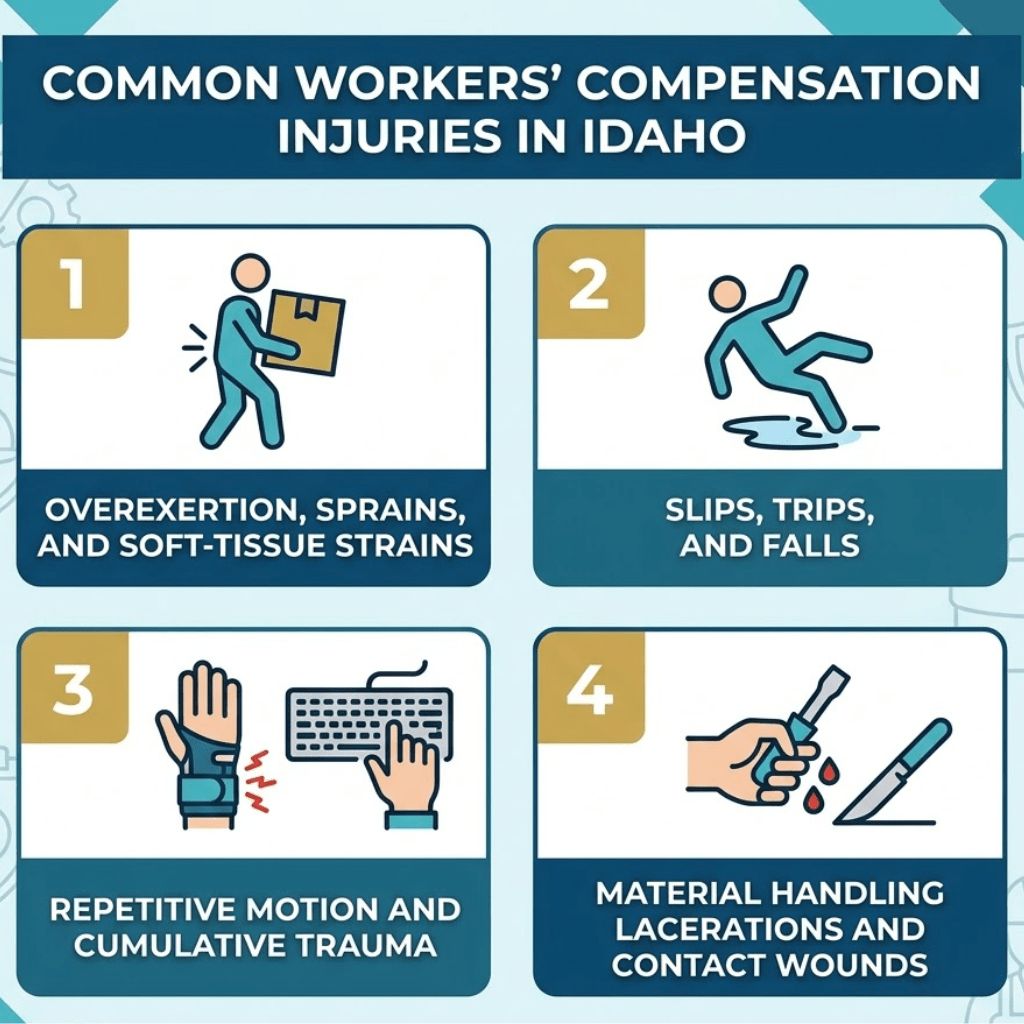
Every year, thousands of individuals across Idaho go to work in diverse sectors—ranging from agriculture and dairy operations to construction, health services, food manufacturing, and traditional office environments. While modern workplace safety standards have made notable strides, on-the-job injuries remain an ongoing reality for employers and employees alike. Understanding what these frequent injuries look like, and the procedural requirements governing them under Idaho law, is essential for preserving safety and understanding your legal rights.
The Most Common Workers’ Compensation Injuries in Idaho
Based on aggregated historical statistics from the Idaho Industrial Commission, reported workplace injuries frequently fall into specific, predictable physical categories:
1. Overexertion, Sprains, and Soft-Tissue Strains
Musculoskeletal injuries constitute the single largest category of workers’ compensation claims across virtually all lines of work. These injuries usually involve the stretching or tearing of ligaments (sprains) or muscles and tendons (strains).
- Primary Drivers: Improper lifting techniques, handling unusually heavy loads, twisting awkwardly while moving equipment, or sudden physical bracing during a manual task.
- Vulnerable Sectors: Healthcare staff (manually transferring patients), transport drivers, logistics personnel, and agricultural workers handling livestock or heavy farm equipment.
2. Slips, Trips, & Falls
Falls generally break down into two broad administrative groups: falls on the same level (slipping on a surface) and falls from elevated heights.
- Primary Drivers: Idaho’s severe winter weather frequently plays a role, introducing ice and slick conditions across parking fields and exterior job walks. Internally, wet surfaces, cords left unmanaged across corridors, and unsecured ladders or scaffolding contribute significantly.
-
Vulnerable Sectors: Structural construction workers, retail employees, commercial roofing teams, and food service staff handling slick kitchen environments.
3. Repetitive Motion and Cumulative Trauma
Not all workplace harm materializes from an acute, sudden event. A substantial volume of claims is derived from cumulative physical wear occurring gradually over months or years.
- Primary Drivers: Performing identical physical mechanics continuously throughout the work shift without adequate ergonomic variance. This can manifest as carpal tunnel syndrome, progressive lumbar strain, or tendonitis.
- Vulnerable Sectors: Data entry and office personnel, assembly line workers in manufacturing units, and heavy machine or long-haul transport operators who encounter constant vehicular vibration.
4. Material Handling Lacerations and Contact Wounds
Cuts, punctures, and crush injuries often involve severe trauma to the hands, fingers, and extremities.
- Primary Drivers: Direct interaction with poorly guarded power machinery, tool malfunctions, handling jagged raw building materials, or working without proper protective equipment (such as reinforced gloves).
- Vulnerable Sectors: Meat processing facility workers, commercial timber operations, mechanical repair shops, and agricultural maintenance fields.
Navigating a Claim Safely
Idaho strictly administers a no-fault workers’ compensation framework. This implies that an injured worker does not need to show negligence or fault on behalf of the employer to be eligible for medical or wage benefits, provided the injury arose directly out of and occurred within the lawful scope of employment. However, specific regulatory timelines must be followed meticulously to safeguard these benefits.
If you or someone you know sustains an on-the-job injury, taking the proper systematic steps will help ensure a clear record: immediately notify a supervisor, seek a professional diagnosis from an authorized medical provider, clearly state to the treating clinician that the event occurred at work, and ensure that an explicit, written First Report of Injury is processed. If challenges surface regarding medical coverage or claim adjustments, call Caldwell Law Group, P.L.L.C. Our team can help clarify your choices within the bounds of Idaho law.
LEGAL ADVISORY AND ADVERTISING DISCLAIMER:
This publication has been prepared by the Law Offices of Caldwell Law Group for informational and educational purposes only. It does not constitute formal legal advice, and the information contained herein should not be acted upon without first seeking individualized, professional legal counsel regarding your specific circumstances.
The transmission, receipt, or reading of this information does not initiate, create, or constitute an attorney-client relationship between the reader and this firm or any of its attorneys. While we endeavor to maintain accurate and contemporary legal summaries, laws frequently change, and information may not reflect the absolute latest developments in Idaho jurisprudence.
This communication may be deemed “Attorney Advertising” under the applicable provisions of the Idaho Rules of Professional Conduct. The hiring of an attorney is an important decision that should not be based solely upon advertisements or web articles.