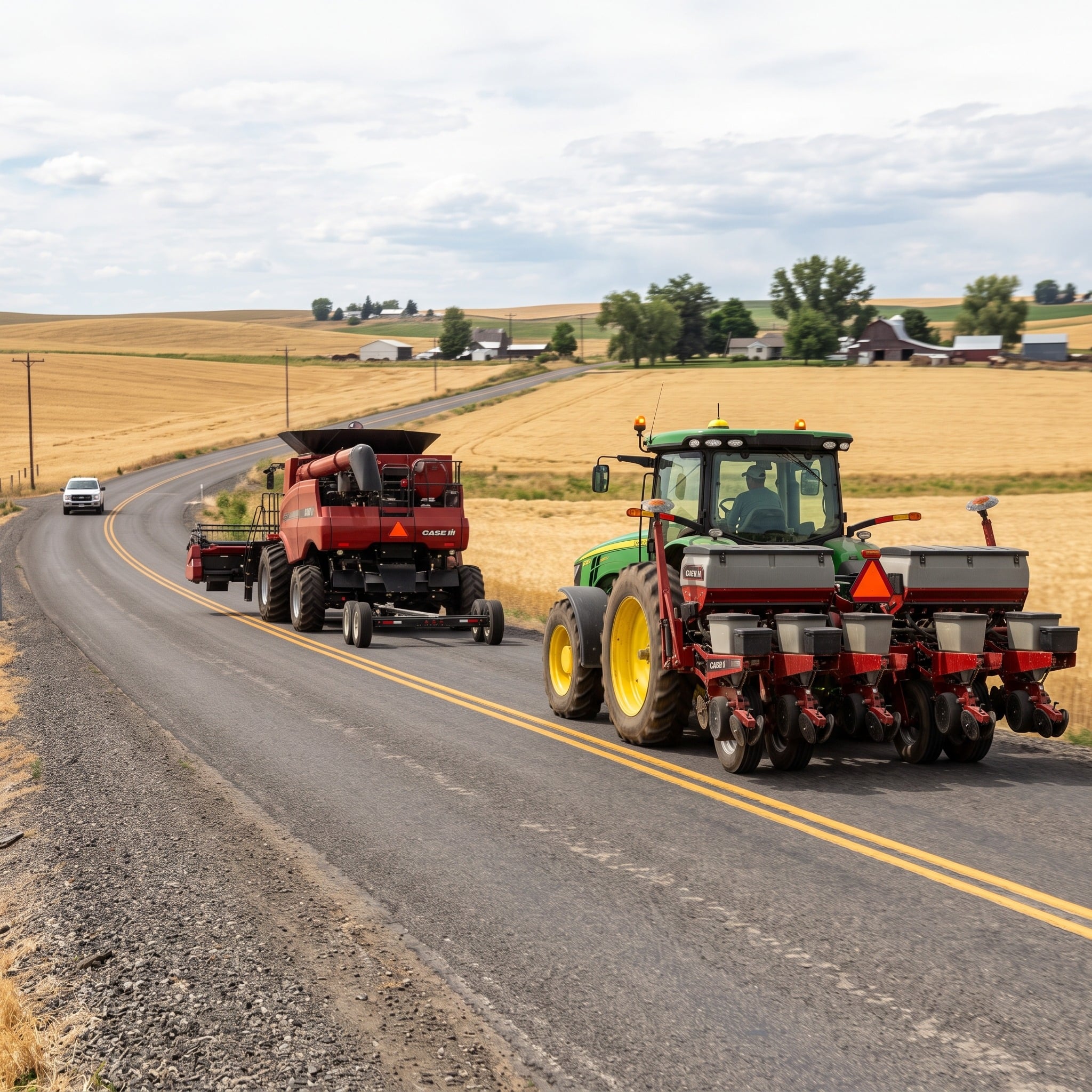
Every spring planting and autumn harvest season, drivers across the Pacific Northwest—from Idaho’s Magic Valley and Treasure Valley to the rolling hills of the Palouse and Yakima Valley—encounter a common sight: massive combines, tractors, sprayers, and grain trucks navigating two-lane rural highways.
While agricultural equipment is the lifeblood of our local economies, it also introduces significant hazards to rural transit. Heavy machinery moves slowly, takes up more than a single lane, and creates severe blind spots.
When passenger vehicles collide with agricultural machinery weighing tens of thousands of pounds, the outcome is frequently catastrophic. Understanding the rules of the road, recognizing the rights and duties of both parties, and knowing how liability is evaluated can prevent tragic crashes and protect your rights if an accident does occur.
1. The Physics of the “Closing Gap”
The single biggest danger in rural driving isn’t the equipment’s width—it’s speed differential.
Most agricultural implements are legally classified as Slow-Moving Vehicles (SMVs), designed to travel at speeds no greater than 25 mph (though certain specialized modern tractors may reach up to 35–40 mph). If you are driving the standard 55 to 65 mph on a rural highway and come over a hill or around a bend toward a combine traveling at 20 mph, you can close a 300-foot gap in fewer than four seconds.
The Fluorescent Orange Triangle
Under both Idaho and Washington law, any vehicle designed to travel at 25 mph or less must display an official Slow-Moving Vehicle (SMV) emblem—a reflective orange triangle with a red border—mounted on the rear.
2. Navigating Overtaking and Passing Safely
Overtaking farm machinery is the leading cause of rural intersection and roadway collisions. Drivers often become impatient behind a tractor moving at 15 mph, leading to reckless passing attempts.
Before passing, consider these critical rules:
-
Watch for the “Left-Turn Illusion”: This is one of the most frequent collision scenarios. A tractor operator will often swing wide to the right before executing a wide left turn into an unmarked field gate or access road. Impatient motorists behind them often interpret this movement as pulling over to let them pass—initiating a pass just as the heavy equipment turns left directly across their path.
-
Double Yellow Lines and Blind Curves: Passing on a solid yellow line, on a curve, near a railroad crossing, or over the crest of a hill is strictly illegal. The height of farm machinery often completely blocks your forward view of oncoming traffic.
-
Turnout Obligations: Both Washington (RCW 46.61.427) and Idaho statutes specify rules regarding slow-moving traffic delaying following vehicles. However, heavy equipment operators cannot simply pull onto soft, unpaved shoulders or steep ditches without risking a rollover. Be patient and wait until the operator reaches a paved pullout, driveway, or safe road widening.
3. Oversized Implements and Blind Spots
Modern agricultural equipment—such as grain platforms or multi-row sprayers—often exceeds the width of a standard 10- or 12-foot travel lane.
-
Equipment May Straddle the Centerline: Operators are permitted to transport oversized farm equipment to and from fields, provided they follow state safety regulations regarding escort vehicles, hazard flashing lights, and daylight transport rules.
-
Massive Blind Spots: Tractors pulling large implements have virtually zero rear visibility directly behind the trailer or implement. If you are tailgating, the operator cannot see you. Maintain a trailing distance of at least 3 to 4 car lengths so your vehicle remains visible in their side mirrors.
4. Who Is Liable in a Farm Equipment Collision?
Determining fault in a collision involving farm equipment is rarely straightforward. Agricultural accidents involve complex state transportation codes, equipment safety standards, and comparative negligence rules.
Potential Farmer / Equipment Owner Negligence:
An operator or agricultural business may be found liable if they:
-
Operated before sunrise or after sunset without legally mandated illumination, reflectors, or flashing amber beacons.
-
Failed to display a valid, clean SMV emblem.
-
Failed to use pilot/escort vehicles when required for extreme, permit-level widths.
-
Made an improper left turn without checking behind or signaling.
-
Allowed mud, gravel, or debris to create hazardous road obstructions without remediation.
Potential Motorist Negligence:
A passenger vehicle driver may be found negligent if they:
-
Exceeded the speed limit or drove too fast for rural road conditions.
-
Attempted an illegal pass across solid lines or within 100 feet of an intersection.
-
Tailgated the equipment, causing a rear-end collision.
-
Failed to heed flashing hazard signals or pilot cars.
Comparative Fault: Idaho vs. Washington
Both states handle shared fault differently, which can drastically impact your case:
| State |
Fault Rule |
How It Works |
| Washington |
Pure Comparative Negligence |
You can recover damages even if you are at fault, but your recovery is reduced by your share of fault. |
| Idaho |
Modified Comparative Fault (50% Bar) |
You can only recover damages if your fault is less than 50%. If you are found 50% or more responsible, you are barred from recovery. |
What to Do After an Accident Involving Farm Machinery
-
Call 911 Immediately: Ensure state troopers or county sheriffs document the scene. Rural crash investigations require accurate skid-mark mapping, implement measurements, and equipment lighting verifications.
-
Photograph the Scene Thoroughly: Capture the positioning of all machinery, tire tracks, field access points, reflectors, SMV emblems, and lighting conditions before the equipment is moved.
-
Identify Witnesses: Obtain names and contact details of other drivers or nearby field hands who witnessed the collision.
-
Seek Medical Attention Promptly: Even if you feel uninjured, adrenaline masks severe soft-tissue or internal trauma common in heavy collisions.
-
Consult an Experienced Rural Injury Attorney: Collisions with commercial farms often involve commercial farm policies, complex liability assessments, and specialized machinery mechanics.
Protecting Pacific Northwest Families
Whether you are commuting across state highways or working to bring in the season’s harvest, road safety is a shared responsibility. By slowing down, staying patient, and leaving adequate space, we can help ensure everyone makes it home safely.
If you or someone you love has been injured in a collision on an Idaho or Washington road, reach out to our dedicated legal team today for a free, confidential case evaluation.